Behavior charts for students old enough to be embarrassed by one.
A sticker chart on a fourteen-year-old's binder fails for a reason that has nothing to do with whether they need structure. These layouts follow a student through six teachers, let them rate themselves, and look like a form rather than a reward.
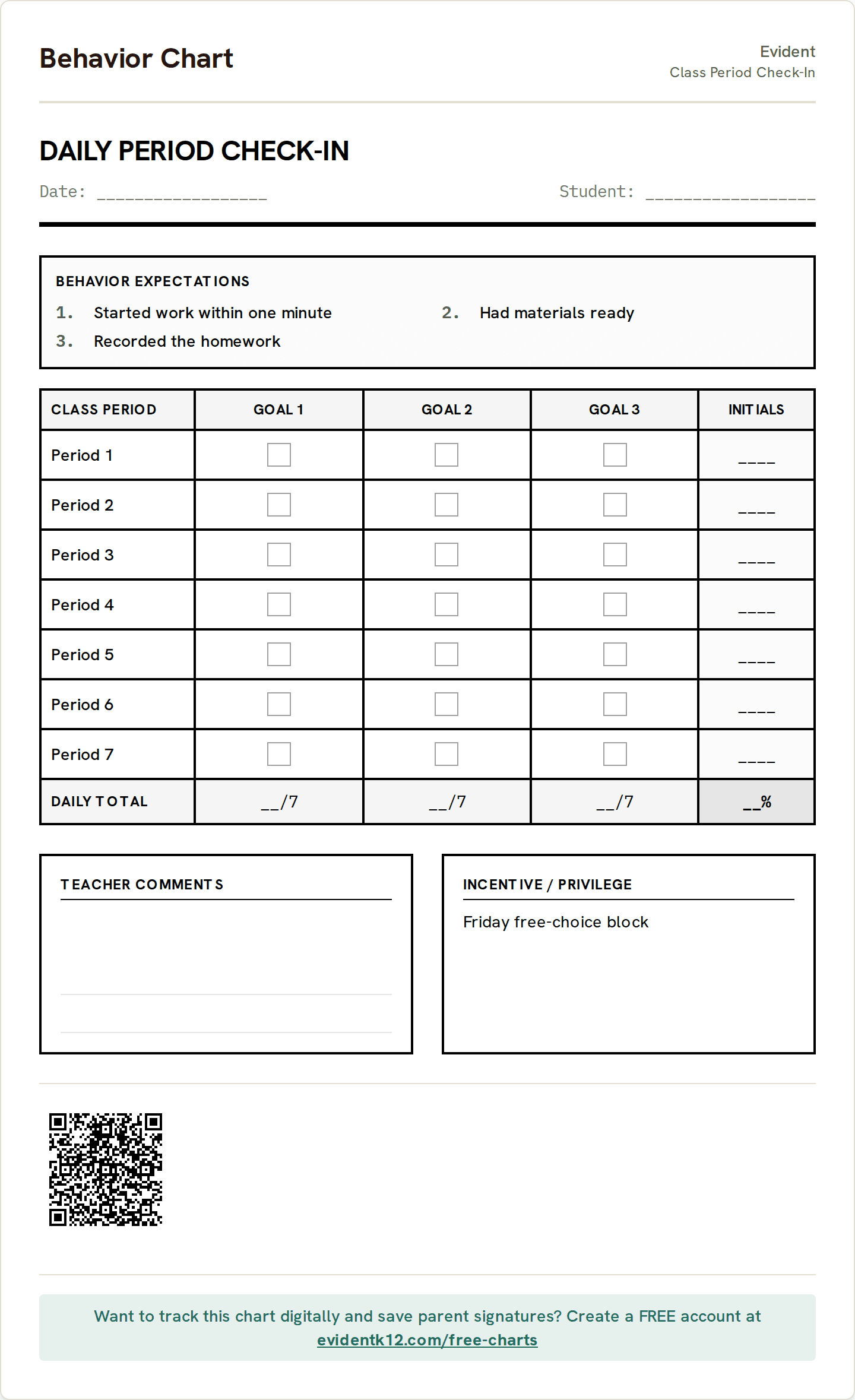
Seven teachers, and nobody sees the day.
Elementary tracking assumes one adult watches one student all day. Middle and high school breaks that assumption completely: six or seven teachers each see forty-five minutes, and the pattern that matters (the class where it always falls apart, the slide after lunch, the week it started) is exactly the thing no single one of them can see. Meanwhile the tool that worked in third grade now announces to a room full of adolescents that this student is being watched, which is the fastest way to make a teenager stop caring about it.
Built for a schedule, not a classroom.
Class Period Check-In
One row per period, a box for each teacher's initials, and a daily total. The pattern across six or seven classrooms shows up on one sheet instead of living in six gradebooks nobody compares.
Student Self-Assessment
Turn on student entry and the student rates the same goals you do, from their phone, in the family portal. Their rating and yours sit side by side, so the conversation becomes about the gap rather than about your word against theirs.
Executive Function Tracking
Ten pre-written goals for task initiation, materials, planning, and turning work in: the skills that actually decide a secondary student's grades. Hard-ruled weekly layout, no decoration.
Behavior Contracts
Measurable goals, what the student earns, and three signature lines on one page. The document a dean, a student, and a parent can all sign at the end of a meeting.
Private By Default
No points on the wall, no class leaderboard, no public ranking. A chart a fourteen-year-old will carry is one nobody else in the room can read.
Progress Reports
Daily marks roll into trend charts over weeks and months, with the student's own ratings included when self-assessment is on. Export a PDF for the IEP meeting or the 504 review.
Transition Goals
Post-secondary transition goals (self-advocacy, disclosure, career exploration) track the same way as everything else, so the transition section of the IEP has real data behind it.
Family Updates
The day's check-in goes home and opens on a parent's phone, in their own language, with no app and no login. Covers 28 languages.
Let the student rate themselves.
Self-monitoring is the version of this that fits an older student, and it builds a metacognitive skill rather than a compliance one: notice your own behavior, compare it to a standard, record it. Turn on student entry and they submit their rating from their phone; the self-monitoring rubric prints student and teacher columns side by side, rated 1-4 independently. The gap between the two columns is the conversation worth having, and it narrows as calibration improves.
The research, what it does and does not show, and how to build a rubric a teenager will use: self-monitoring in high school.
Start with goals written for this age band.
Not “keeps hands to self”. The executive-function and transition categories in the goal library are written for secondary students and drop straight into any layout.
Will a middle or high school student actually use a behavior chart?
Not a sticker chart, no. The format that fits older students is self-monitoring: the student rates their own behavior against a defined standard and an adult checks the accuracy at first. A 2022 meta-analysis in the International Journal of Educational Research pooled 36 experimental studies (2,617 students) and found moderate gains in academic performance. Sixty percent of those studies were in higher education and the rest in K-12, so read it as good evidence for the practice at this age rather than proof of any one high school program. Our layouts for grades 6-12 have no faces, no stickers, and nothing that reads as a reward chart.
How does tracking work when a student has seven different teachers?
The class period check-in is one sheet with a row per period and a box for each teacher's initials. The student carries it, each teacher takes five seconds, and by the end of the day the pattern across the whole schedule is on one page, which is exactly what a per-classroom points app cannot show you.
Can the student rate themselves instead of the teacher doing it?
Both, which is the point. Enable student entry on the chart and the student submits their own rating from the family portal on their phone. The self-monitoring rubric prints the same way: student column and teacher column, rated 1-4 independently. Where the two disagree is the useful conversation.
Is anything visible to the rest of the class?
No. There is no leaderboard, no public points display, and no class ranking anywhere in the product. A teacher sees their own students, the support team sees what its role allows, and the student's sheet is the student's.
Does this feed IEP and 504 progress monitoring?
Yes. The same daily check-ins build the trend data, so an executive-function or transition goal that a team writes in the fall has months of dated evidence behind it by the review, without a separate data sheet.
Is it free?
Printing charts is free and needs no account: pick a layout, set the goals, print. An account adds the saved roster, the trend data, the family portal, and the exported reports.
Want paper first? The class-period check-in, self-monitoring rubric, and behavior contract open in the free chart maker. Comparing tools for a middle school? Read ClassDojo alternatives for middle school.
Walk into the meeting with the pattern across all seven periods.
Every check-in is dated and attributed. By the review, the team can see which class, which time of day, and which week things changed, and what the student said about it themselves.