Behavior Contract Template for Students: What Goes In It, a Filled Example, and a Free Printable
Behavior contract template for grades 3 to 12: the seven parts, filled examples for grade 4 and grade 9, goals students can meet, and a free printable.
What's free: print any chart with no account. Track a whole class online free: 30 students, a goal chart each, family portal included. Pro adds PDF reports for $12 a month.
See the free planA behavior contract is a short written agreement between a student and an adult: here is the behavior we are working on, here is how we will know it happened, here is what you earn when it does, and here is what happens when it does not. Everyone signs. Everyone keeps a copy. The team meets again on a date written at the bottom.
Most behavior contract templates online are a page of blanks with a line for a signature. The blanks are not the hard part. The hard part is writing a goal the student can actually meet on Tuesday, picking a reward that still works in week three, and keeping the contract from turning into a list of things the student did wrong. This post covers what goes in a contract, a filled example for an elementary student and a teenager, the ways contracts fail, and a free printable version you can open and edit in about two minutes.
What a behavior contract is, and is not
The research name is a contingency contract: a written statement of the relationship between a behavior and its consequence, agreed to in advance by the people involved. The evidence base is old and reasonably solid. A 2015 meta-analysis of single-case studies in Behavior Modification found behavior contracts produced moderate improvements in both behavior and academic outcomes for school-age students, with the largest effects when the student helped set the terms.
That last clause is the whole point. A contract is a negotiation. It works on students who would resent a chart handed to them, especially students in grades 6 through 12, because it treats them as a party to an agreement rather than the subject of a plan.
A behavior contract is not:
- A discipline letter. If the document only lists what the student must stop doing and what will happen if they do not, it is a warning with a signature line. Students sign warnings and ignore them.
- A substitute for a behavior plan. If the behavior is dangerous, happens many times a day, or has not responded to anything a classroom can offer, the student needs an FBA and a behavior intervention plan, not a contract. A contract can sit inside a BIP as one strategy. It cannot replace one.
- Permanent. A contract has an end date. Four to six weeks is typical. If it is working, you fade it or write a new one with a harder goal. If it is not, you change it. A contract that has been "in effect" since September and that nobody has looked at since October is a piece of paper.
When to use one
Contracts fit a particular situation: one student, one or two specific behaviors, a student old enough to understand a deal and keep a copy, and an adult who can check in on a schedule. In practice that means:
- A Tier 2 intervention for a student whose behavior is disruptive but not dangerous, after whole-class systems have not been enough.
- A return from suspension or a serious incident, where the student, the family, and the school need to agree on what "back on track" looks like in writing.
- A 504 plan or IEP behavior goal that the student is old enough to own. The contract makes the goal visible to the student in their own words.
- A middle or high school student who has been through sticker charts and is not going to carry another one. See why behavior charts belong in high school too for the research on self-monitoring at that age.
If the student is in kindergarten or first grade, a daily check-in chart with a picture of the reward usually does the same job with less paperwork. Contracts start working reliably somewhere around third grade, when a student can hold "if I do this for a week, then that" in mind across days.
The seven parts
Every usable contract has these, in roughly this order. If your template is missing one, add it.
1. The target behavior, stated as what to do
Write the behavior the student will do, not the one they will stop. "Keep hands and objects to yourself during carpet time" is a target. "No hitting" is a rule the student already knows. The difference matters because the contract is going to be checked several times a day, and "did you keep your hands to yourself" has a yes or no answer in a way that "did you not hit" does not, especially on a day that was mostly fine.
Keep it to one or two behaviors. Three is the ceiling. A contract with six goals is a code of conduct.
2. How it will be measured
Who checks, when, and what counts. "Ms. Rivera marks yes or no at the end of each period" is a measurement. "The student will try their best" is not. The measurement is what makes the contract a record rather than a promise, and it is the part that a Tier 2 meeting, a 504 review, or an MTSS packet will actually ask for later.
3. The criterion
How much is enough to earn the reward. "4 out of 5 days this week" or "at least 5 of 7 periods marked yes" or "no more than one reminder per class." Set the first criterion where the student can hit it in the first week. A contract where the student earns nothing for a week teaches them the contract is rigged, and no later adjustment fixes that.
4. The reward, chosen by the student
Ask what they want. Then negotiate. The reward has to be something the adult can actually deliver, on the day it is earned, without asking anyone else. Ten minutes of a preferred activity, a note home that says what went well, first choice of seat, a pass to eat lunch with a friend in the classroom. The reward menu examples resource has lists by grade band. Money and large prizes are a mistake: they are hard to deliver, they make the contract about the prize, and they stop working the week the prize is spent.
5. The consequence for not meeting it
Keep this short and already-known. Usually the consequence is simply that the reward is not earned and the usual classroom rules apply. If you add something, make it something that would have happened anyway. A contract whose consequence section is longer than its reward section reads as a threat, and students read that correctly.
6. The review date and who is at the review
Four weeks out, written on the page. At the review you look at the marks, not at memories. The student is in the room. If the goal was met most weeks, raise the criterion or fade the check-ins. If it was not, change the goal, the measurement, or the reward, and write a new contract. The review is where most of the learning happens, for the adult as much as the student.
7. Signatures
Student, teacher, and a parent or guardian. Three lines. The parent's signature is not a formality: it means someone at home knows what the student is working on and can ask about it. Send a copy home in the family's language if that is not English. The printable below translates.
A filled example, elementary
Student: Jordan M., grade 4
What I will do: Start my independent work within two minutes of the directions, without being asked twice.
How we will check: Mr. Okafor marks yes or no on my chart after each independent work block (3 per day).
Goal this week: Yes on 10 or more of 15 blocks.
What I earn: On Friday, if I reach 10, I pick the read-aloud book for Monday.
If I don't reach it: I don't pick the book this week. We talk about what got in the way and try again Monday.
Review: Friday, four weeks from today, with Mr. Okafor and Mom.
Signed: Jordan M. / Mr. Okafor / Dana M.
Notice what is not in it. No "stop wasting time." No "attitude." Nothing the student cannot picture themselves doing at 9:40 tomorrow.
A filled example, teenager
Contracts for middle and high school students need two changes. The student should write or co-write the goal in their own words, and the check-in should happen once per class period, because a ninth grader who is fine in biology and a mess in English is not having a bad day, they are having a bad period.
Student: Alexis R., grade 9
What I'm working on: Being in my seat with my notebook out when the bell rings, every period.
How it's checked: Each teacher initials the "on time and ready" box on my period sheet. I carry it. If I lose it, that day doesn't count against me but it doesn't count for me either.
Goal: At least 5 of 7 periods initialed, 4 days out of 5.
What I get: A Friday pass to the library during study hall, which I asked for.
If I don't hit it: No pass that week. Ms. Chen and I look at which periods are missing and whether something about those periods needs to change.
Review: In four weeks, me, Ms. Chen, and my dad. Dad can join by phone.
Signed: Alexis R. / Ms. Chen / R. Ramirez
The "if I lose it" line is there because the student who most needs the contract is the student most likely to lose the sheet between third and fourth period. Decide in advance what a lost sheet means, or the contract dies the first time it happens.
Writing goals a student can meet
The goal wording is what separates a contract that runs for a month from one that gets forgotten in a week.
- Make it observable. Someone who does not know the student should be able to watch for five minutes and say whether it happened.
- Make it small. One behavior, in one setting, during one part of the day, is a goal. "Be respectful" is a value.
- Put a number on it. Within two minutes. No more than one reminder. Five of seven periods.
- Start where the student is. If the student currently starts work on time about one day in five, a goal of five in five is a setup. Two in five, then three, then four.
- Use their words where you can. "Don't lose it with Mr. Ortiz" is not printable. "Use a calm voice when I'm frustrated," written after that conversation, belongs to the student in a way the template wording never will.
If the goal comes from an IEP or 504 plan, the measurable goal wording bank has phrasings that already have a measurement built in.
How contracts fail
A contract that is not working usually has one of five problems, and each one has a fix that does not involve giving up on the contract.
- The criterion was set at the finish line. The student never earned the reward and stopped caring by day four. Lower it until they earn it once, then raise it.
- Nobody checked. The teacher forgot on busy days, so the marks have gaps, and the student noticed that the gaps were on the days they did well. Put the check at a fixed moment (the last minute of each period, the transition to lunch) and make it visible on the sheet.
- The reward went stale. Week one, free time was exciting. Week three, it was Tuesday. Let the student change the reward at the review, or offer a short menu.
- It became public. The sheet got left on a desk, a classmate read it, and the student tore it up. Contracts live in a folder or on a screen, never on a wall. The case against public behavior charts applies in full.
- The behavior has a function the contract cannot touch. A student who disrupts because the work is too hard will not stop disrupting for a library pass. If the contract is failing and you have fixed the first four, the next step is ABC data, not a better reward.
Our guide to the six fixes when a behavior chart stops working covers the same ground for charts, and most of it transfers.
The free printable
The behavior contract template in Evident's free chart maker is two pages: up to five measurable goals, a five-day grid for the check marks, the reward and the criterion, and three signature lines. It was built for grades 6 through 12 and works from third grade up.
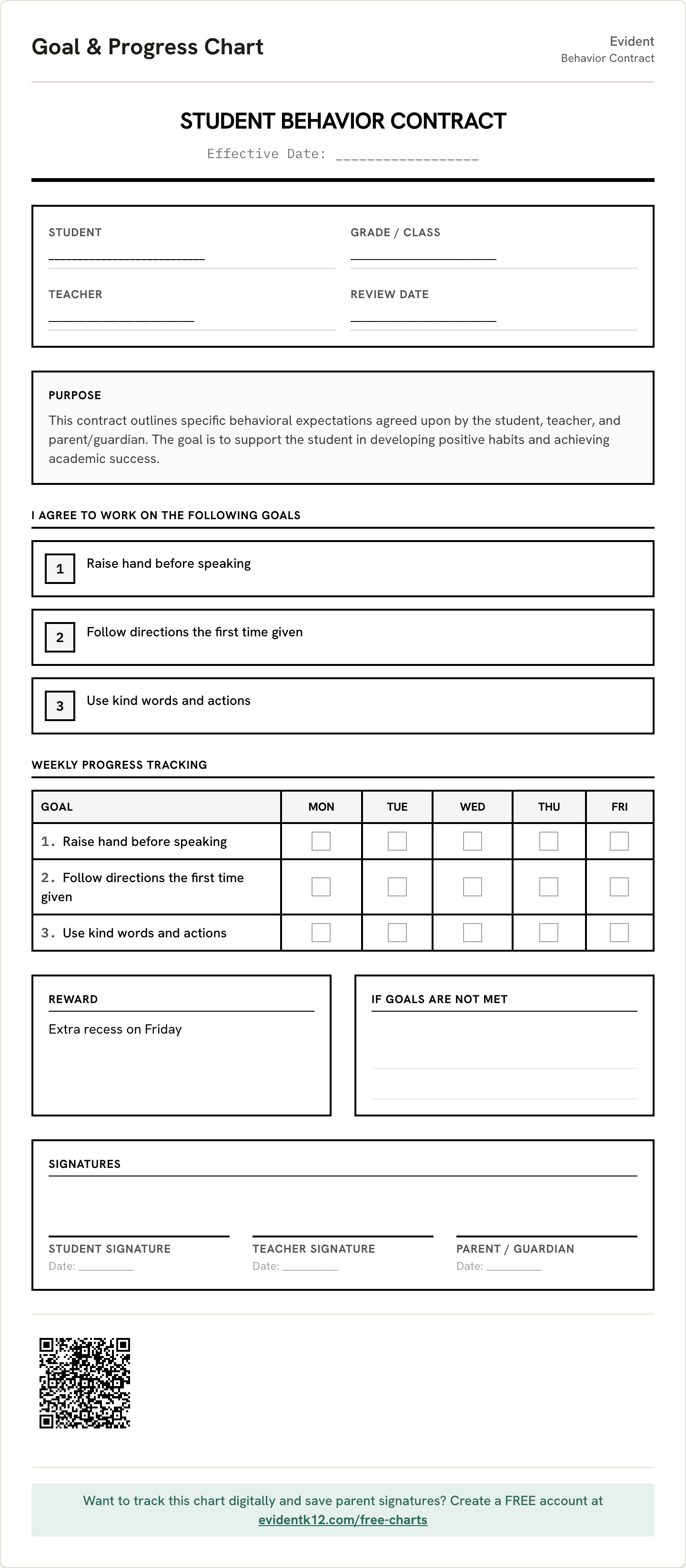
To use it:
- Open the behavior contract template. No account is needed to print.
- Type one or two goals, or pull them from the goal library and edit the wording with the student.
- Write in the reward and the criterion.
- Translate it if home speaks another language. The bilingual version prints both languages on the same page.
- Print two copies: one for the student's folder, one for home.
If the contract is a formal intervention and the marks need to be a record, make the same contract in a free account instead of printing it. Each teacher marks their period on their own screen, the student's sheet cannot be lost, the marks become dated data points, and the review meeting opens with a graph rather than a stack of sheets. The free plan covers a class of up to 30 students and does not expire. Middle school charts covers the period check-in and self-monitoring rubric that pair with a contract at that age.
Go deeper in the resource library
- Classroom reward menu examples for teachersExample · 7 min read
- Self-Monitoring Rubric for Middle and High SchoolTemplate · 7 min read
- MTSS tier documentation checklistChecklist · 4 min read