A student behavior tracker for teachers that keeps the record for you.
A behavior tracker built for teachers: log each goal in seconds, and every mark is kept as a dated data point, so the trend is there when you need it and the whole class is one view. Families follow along by phone. Free for a full class of up to 30 students.
Most behavior tracking stops at the end of the week.
A clipboard, a spreadsheet, or a points app all capture the moment. None of them keeps the record in a shape that answers the question a teacher is actually asking six weeks later.
The paper log goes home in the folder and does not come back. The week that mattered is the week with no data.
The spreadsheet holds the marks, but the chart, the family note, and the progress summary are all rebuilt by hand, by one person, in one Drive.
The points app resets. Monday's total says nothing about whether the goal has been met more often since September.
Track goals, not points. Keep every mark.
The daily routine is the same one you already do on paper. What changes is everything that used to happen after school.
One tap per goal, per day
Mark each goal met or not met from the roster, a student page, or the quick log. Two goals, five days, thirty students is still under five minutes at the end of the day.
The trend answers the question
Every student page shows the last two weeks at a glance and the day-by-day record beneath it. "Is this working?" gets answered from the data, not from memory at the conference.
The whole class in one view
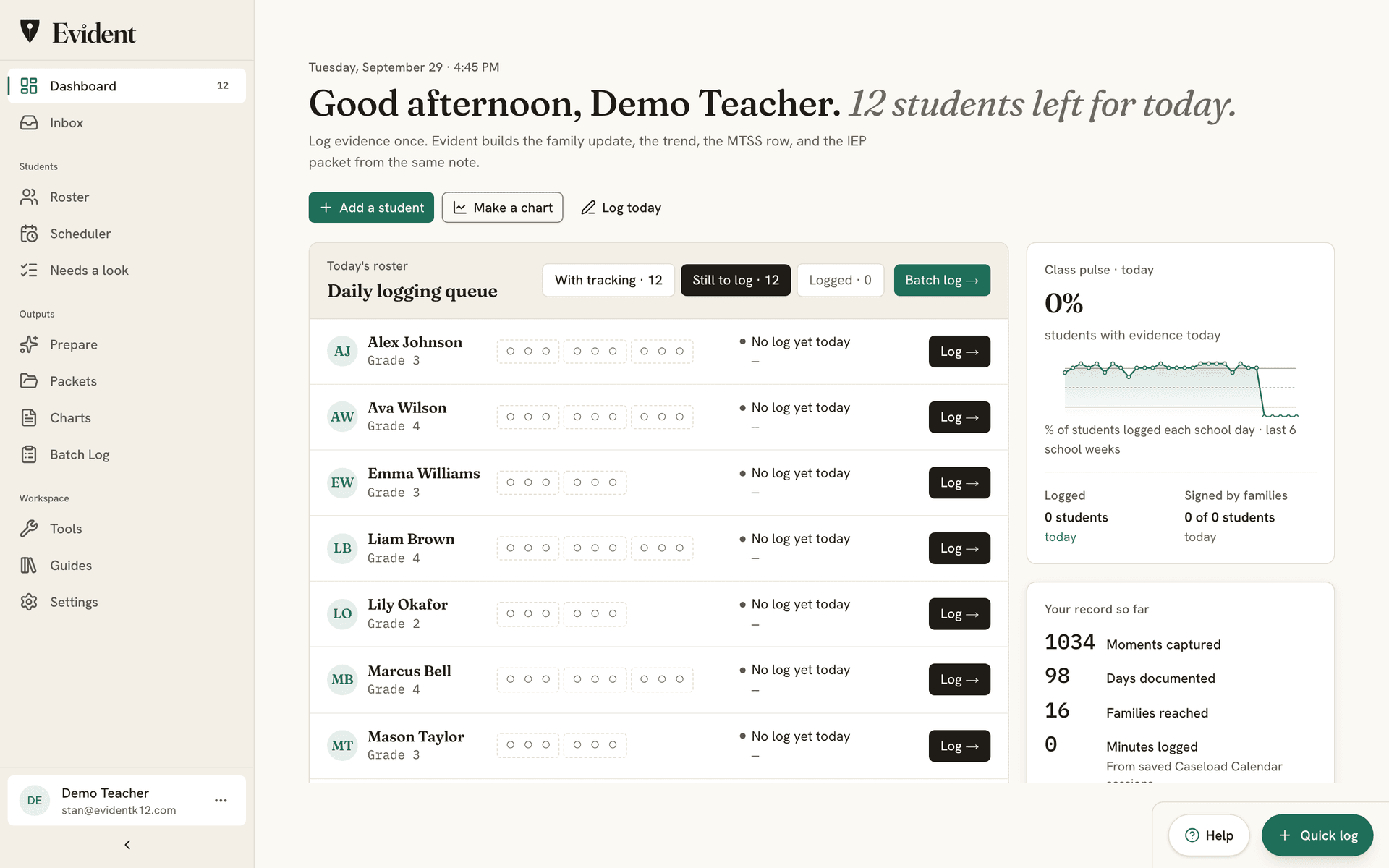
The dashboard lists every student with a chart, what was logged today, and who has not been logged yet, so nobody's record quietly goes blank for a week.
Families follow along, no app
Each student has a family link and a QR code on the printed chart. Today's marks show on a phone in the family's own language, and they can sign off digitally.
Tracks online, still prints
Every one of the 14 chart layouts prints on US Letter or A4 with the QR code in the corner. Paper on the desk and the digital record are the same chart.
Becomes evidence when it needs to
Six weeks of daily marks is six weeks of dated data points. When a student moves to a Tier 2 conversation or an IEP review, the record is already there, ready for a progress report.
Spreadsheet, points app, or goal tracker?
All three are free to start. They differ in what you have at the end of the quarter.
| What you get | Behavior tracking spreadsheet | Points app | Evident behavior tracker |
|---|---|---|---|
| What it records | Whatever you type in the cell | Points given or taken, then reset | Each goal met or not met, per day, kept |
| Daily entry | Open the sheet, find the row, type | Tap a point | Tap met or not met from the roster or quick log |
| Trend over weeks | Build a formula and a chart yourself | Weekly totals, then gone | Two-week snapshot and day-by-day history per student |
| Whole-class view | One tab per student, or one giant grid | Leaderboard | Roster with today's status, no ranking |
| Family view | Share the file or screenshot it | Requires the family to install the app | Phone link or QR code, no app, digital sign-off |
| Translation | Copy each line into a translator | Some languages, in-app only | 28 languages, one click |
| Paper copy | Print the grid | No | Every layout, with the QR code |
| Meeting evidence | Export and reformat | Point totals | Dated marks become a progress report (paid plan) |
Want the chart on paper first? The free chart maker makes one in two minutes, the printable library has a ready-made chart for 150+ goals, and the digital behavior chart page shows what one student's tracked chart looks like.
Check-in/check-out and self-monitoring, ready to track.
A CICO card, a class period sheet, a behavior contract, and a self-monitoring rubric for secondary students. Pick goals and a reward, see the chart as you build it, then print it or track it digitally for up to 30 students free.
When the behavior is heading toward a plan, the free ABC data sheet records the antecedent, behavior, and consequence on paper, and the BIP draft builder turns what the team found into a one-page draft to review.
The classic CICO card: three to five goals and a face to circle each day, reviewed at check-out and sent home.
Open this layoutClass Period Check-InOne row per class period with a box for each teacher's initials, for students who change rooms through the day.
Open this layoutBehavior ContractMeasurable goals, the reward the student chose, and signature lines for the student, teacher, and family.
Open this layoutSelf-Monitoring RubricStudent and teacher rate the same skills from 1 to 4 on their own, then compare. Good for older students building independence.
Open this layoutStart with goals teachers actually track.
Write your own, or pick from 150+ pre-written goals across PBIS, classroom routines, academic habits, self-regulation, social skills, executive function, and IEP-aligned categories.
What is a student behavior tracker?
A tool that records a student's behavior goals day by day and keeps the record so the pattern is visible over time. The teacher marks each goal met or not met; the tracker keeps the history, totals it, and shows the trend. It differs from a behavior chart on paper in one way: the marks are data points, not ink, so nothing has to be tallied or re-entered later.
Is the behavior tracker free for teachers?
Yes. The free plan covers a full class of up to 30 students, each with an active goal chart you can swap any time, daily logging, the two-week snapshot and history, printable charts, translated family updates, and the family portal. No credit card and no expiry. PDF progress reports and evidence packets are on the paid plan.
Can I track the whole class, not just one student?
Yes. The dashboard shows every student who has a chart, what was logged today, and who still needs a log. Students with an IEP show their status and upcoming meeting dates alongside the chart, so a case manager and a classroom teacher can work from the same roster.
How is this different from a points app like ClassDojo?
A points app rewards behavior in the moment and the total resets. A tracker records whether a specific goal was met each day and keeps that record, which is what an intervention, a conference, or a progress report needs. Evident tracks goals rather than points, does not run a public leaderboard, and the family view shows the child's own chart, not a class ranking.
How is it different from a behavior tracking spreadsheet?
A spreadsheet can hold the marks, but every chart, family update, translation, and progress summary is something you build and rebuild by hand. A tracker produces those from the same daily entry. It also does not live in one teacher's Drive: a co-teacher, a paraprofessional, or a case manager can log and see the same record.
Does it work on a Chromebook or a phone?
Yes. Evident runs in the browser on a school Chromebook or a phone. The Chrome extension lets you log a data point from whatever tab is open, and the charts work offline as an installable app and sync when you reconnect.
Can families see the tracker?
Yes. Families open today's chart through a tokenized, read-only link or by scanning the QR code on the printed sheet. It shows in their language, any of 28, and they can sign off digitally. There is nothing to install and no account to create.
Is student data handled responsibly?
Family portal links are tokenized and read-only, evidence notes are private to the teacher by default, and Evident signs data processing agreements with schools. The privacy policy and DPA are published, and the security page explains how student data is stored.
The same daily marks become MTSS and IEP evidence.
A tracker run for six weeks is six weeks of dated data points. When a student moves to a Tier 2 conversation or an IEP review, the record is already there: no re-entry, no reconstructing from loose sheets.